

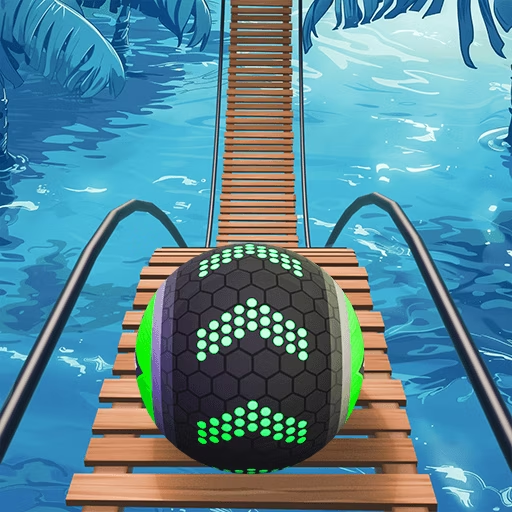





About Go Escape
Go Escape combines automatic rolling with jumps that you trigger yourself. The ball advances while the level presents spikes, moving platforms, rotating blades, and other obstacles. A jump changes how the ball crosses a hazard, but success depends on the space and timing available beyond the takeoff point.
The exit portal gives each stage a defined objective. Repeated attempts can reveal how a troublesome mechanism moves and which approach lets the ball pass safely. This is where observation becomes useful: reacting to the first visible opening is less reliable than recognizing the part of the obstacle's motion that leaves a complete route through the crossing.
How to Play Go Escape
Click, press Space, or use the up arrow to jump as the ball rolls forward. Pass the obstacles and reach the glowing exit portal.
- Watch the ball's automatic approach to the first hazard.
- Use one of the jump inputs when the crossing has a safe opening.
- Read the landing area and the motion of any trap that controls access to it.
- Continue through the level until the ball reaches the exit, revising failed jumps on another attempt.
Controls & Timing
The obstacle has a schedule
A rotating blade or swinging hazard changes the safe space over time. Watch where it will be during the crossing, not only where it is when you begin the jump.
Landing completes the solution
Getting above a spike is only the first part of a move. Identify the surface beyond it so the return does not begin another collision.
Retries reveal a mechanism
A failed attempt shows how the ball and trap meet. Use that information to change one timing decision instead of adding extra jumps without a clear purpose.
Controls
| Input | Action | When to use |
|---|---|---|
| Left mouse click / Space / ↑ | Jump | At a safe moment before an obstacle or gap |
High Score Tips
- Trace the path from takeoff to landing before focusing on the jump button, because some obstacles are solved by their timing window rather than extra height.
- Notice which direction a moving hazard is traveling when you approach, allowing you to distinguish an opening that is growing from one about to close.
- Keep earlier successful jumps consistent so the ball reaches a difficult mechanism with a familiar setup on the next attempt.
- Avoid reflexive additional inputs after a mistake; identify whether a new jump is useful before it changes a recoverable position.
- Treat the exit portal as the final destination while solving the course in smaller transitions, reducing the temptation to rush past an unfamiliar obstacle.
Key Features
- Automatic rolling: The ball supplies forward progress while you time the jumps.
- Mechanical hazards: Moving and rotating obstacles create changing openings.
- Defined level exits: A portal marks the destination for each stage.
- Repeatable timing problems: Retries help you understand a particular crossing.
Frequently Asked Questions
What starts a jump?
Click the left mouse button, press Space, or use the up arrow. The ball already rolls forward, so choose the input when the next obstacle and landing area form a workable crossing.
Is this mainly a puzzle or a reflex game?
It combines both. You need timely input, but observing a trap's movement can reveal a safer crossing window. A level often becomes easier when you understand the mechanism instead of reacting only at contact.
How is a level completed?
Guide the ball to the glowing exit portal. The route includes hazards that can interrupt the attempt, so each successful jump should leave a usable continuation toward that destination.
Why does the same jump sometimes meet a moving trap?
The opening changes as the mechanism moves. Pay attention to its direction and phase during the approach, since a similar jump position does not always mean the trap occupies the same place.
What should I learn from a failed attempt?
Identify the contact that caused the failure and the input that led to it. Keep the successful earlier sequence steady, then adjust that crossing rather than replacing the whole route with hurried jumps.