
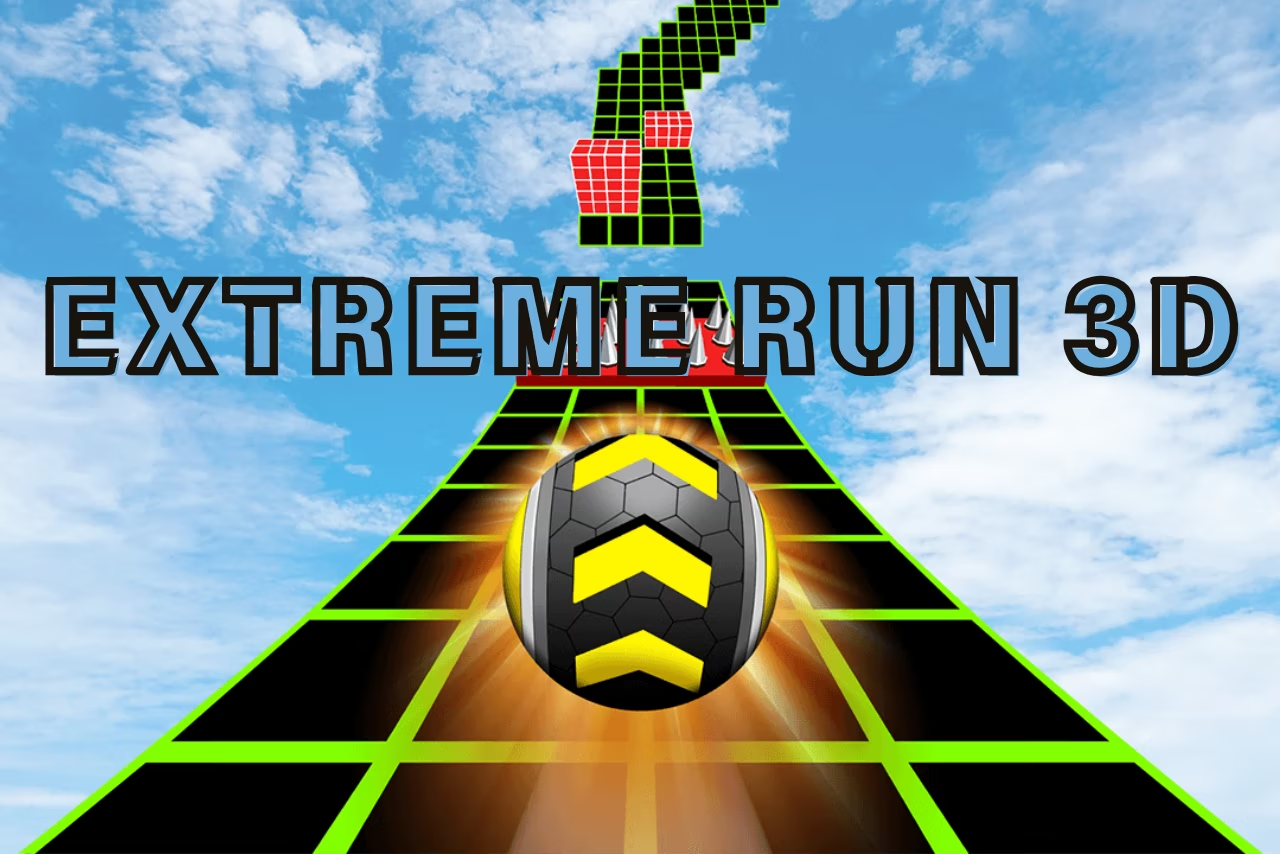





About Extreme Run 3D
Extreme Run 3D separates two jobs that often merge in rolling-ball games: choosing a line across the track and deciding when to leave it. Lateral steering takes the ball around hazards, while jumping deals with breaks that cannot be solved by moving sideways alone. Both actions depend on the surface available after the immediate obstacle.
The courses are presented as levels, giving repeated attempts a specific destination. As layouts become more demanding, a successful move must also prepare the next one. Landing at the extreme edge may clear a gap but leave an awkward approach to the following barrier. Understanding the full transition is more useful than judging a jump solely by whether it crossed the empty space.
How to Play Extreme Run 3D
Use the left and right arrows to steer and the up arrow to jump. Cross the gaps, avoid hazards, and keep the ball on the route toward the level’s end.
- Read the first track section and steer toward its usable surface.
- Use a sideways correction when a hazard leaves room to pass beside it.
- Press the up arrow for a required jump, having identified the landing area first.
- Connect the remaining transitions and reach the end of the course; retry when a fall or collision interrupts the attempt.
Controls & Timing
Steering solves placement
A left-right input changes where the ball approaches the next obstacle. Finish that alignment before a narrow crossing so you are not solving two placement problems at once.
Jumping changes contact
A jump carries the ball away from the track, but it still needs somewhere to return. Read the receiving platform and its next hazard together.
Levels make mistakes reusable
When you repeat a course, the troublesome section becomes a specific problem to study. Keep the successful approach consistent while changing the timing that actually caused the failure.
Controls
| Input | Action | When to use |
|---|---|---|
| ← / → | Steer across the track | To line up with a clear route |
| ↑ | Jump | Before a gap or obstacle requiring an airborne crossing |
High Score Tips
- Read a gap together with the first hazard beyond it, because crossing successfully does not help if the landing puts the ball into an immediate collision.
- Use wider surfaces to finish large lateral changes before entering a narrow section, leaving the limited space for smaller corrections.
- Distinguish a missed takeoff from a misplaced landing when reviewing a failure; they call for different changes on the next attempt.
- Keep a successful opening sequence steady across retries so you arrive at the difficult section with a familiar approach.
- Avoid jumping merely because the next layout is unclear; first identify whether the safe route goes beside the hazard or above it.
Key Features
- Separate steering and jump inputs: Placement and takeoff can be planned independently.
- Three-dimensional routes: Raised tracks and gaps demand attention to the next surface.
- Level-based challenges: Each course offers a destination and a sequence to learn.
- Connected obstacle decisions: The exit from one move shapes the following approach.
Frequently Asked Questions
Does Extreme Run 3D have a jump input?
Yes. The up arrow is documented as a jump control in the supplementary game guides, alongside left-right steering. This allows gap crossings to be planned separately from moving around hazards on the track.
Why do I fall after clearing a gap?
The landing may be outside the usable platform or too close to its edge. Set your lateral approach before takeoff and look at the receiving surface rather than only the gap itself.
Is the goal just an endless distance record?
The selected source describes individual courses that lead to level completion. Work toward finishing the current route and use retries to understand its transitions instead of assuming every attempt has no endpoint.
When should I steer instead of jump?
Steer when the track provides a clear route beside the hazard. Reserve jumping for a crossing that needs airtime and also offers a usable landing, rather than treating it as a universal escape action.
How should I practice a difficult section?
Keep the part you already handle consistent, then change the approach or takeoff that caused the failure. This makes the result easier to interpret than replacing every movement during each retry.